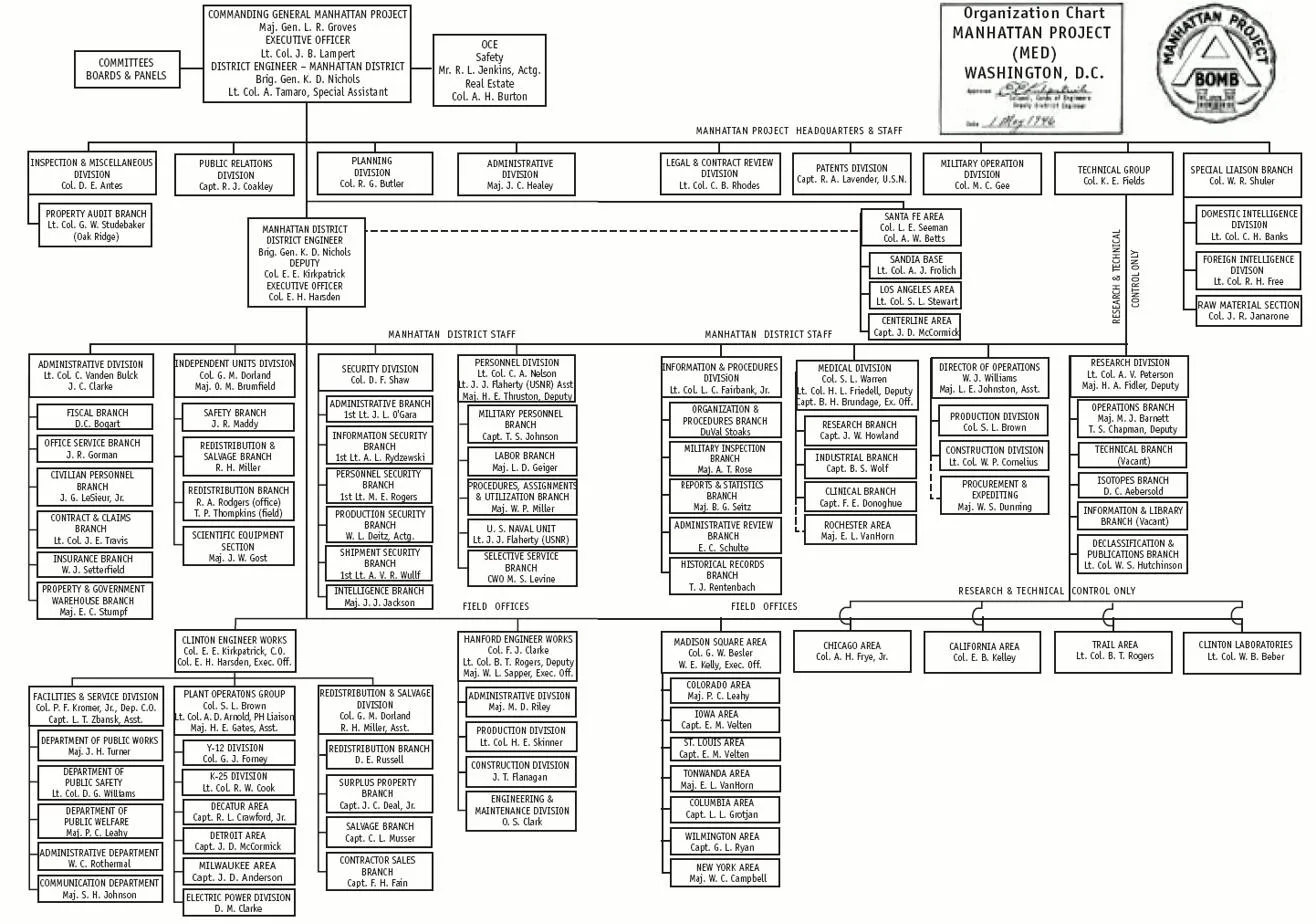
Tap the red-circled boxes to see how each office connects to Lt. Tom Forkner's service — from undercover counter-intelligence work to couriering the uranium that went into the bomb.
-
Commanding General, Manhattan Project
Maj. Gen. Leslie R. Groves
The top of the pyramid. General Groves ran the entire bomb program — every laboratory, factory, and secret city on this chart answered to this box.
Tom never expected to cross paths with the man himself. But after his Oak Ridge tour he was transferred to New York as a security officer for the Manhattan District, and there his work brought him face to face with Groves. He was in Manhattan when Japan's surrender was announced — and only around then did the scale of what he'd been guarding fully come into focus.
-
Manhattan District — District Engineer
Brig. Gen. Kenneth D. Nichols
The Manhattan District was the Army Corps of Engineers organization that actually built and operated the project — and it was the outfit Tom belonged to as a first lieutenant. General Nichols ran it day to day from Oak Ridge, reporting up to Groves.
When Tom talked about being "in the Army intelligence at that time," this district's security apparatus is what he meant. Everything he did in Tennessee and later in New York happened inside this box's chain of command.
-
Security Division
Col. D. F. Shaw
Tom's functional home. The Security Division protected the project's secrets — personnel vetting, information security, production security, and the intelligence work that was Tom's specialty before Oak Ridge ever called.
Its philosophy explains the strangest privilege of Tom's posting: total access. He toured the enrichment buildings, watched the "little buzz machines" splitting atoms, and had two scientists assigned to explain the physics to him.
"You can't protect anything unless you know what you're protecting."The science sailed over his head — by his own account, if the Russians had captured him the next day he "couldn't have helped them one bit." Which, for a security man, was almost the ideal condition.
-
Shipment Security Branch
1st Lt. A. V. R. Wulff
Of every box on this chart, this one describes Tom's job most exactly: an officer responsible for product moving out of Oak Ridge. Tom's recurring mission was to ride security on unmarked trucks from Tennessee to Los Alamos, New Mexico — a 53-hour nonstop run on a preplanned route that avoided every city on the map.
"The only orders I had were: lose it, and you'd better be dead."He was the lone officer aboard, in charge going and coming, and was told almost nothing about the cargo. Only after the war did he learn he had been escorting enriched uranium — material that went into the "Little Boy" bomb dropped on Hiroshima.
Note the rank on this box: a first lieutenant, the same rank Tom held. That's exactly the level at which this work lived — far below the colonels and generals, and invisible on most charts like this one.
-
Intelligence Branch
Maj. J. J. Jackson
This line of work is what got Tom to Oak Ridge in the first place. Recruited into Army counter-intelligence in Atlanta by Asa Candler — a family acquaintance who happened to run the office — Tom spent roughly two years undercover.
He posed as "the sorriest soldier" at Fort Benning to befriend and tail a suspect German-born GI, deserting alongside him and following him to New York for weeks under an assumed name. The man never learned his travel buddy was an agent.
He also ran what we'd now call red-team work: buying a major's uniform downtown, forging an ID with a newspaper clipping, saluting his way past the gate, joyriding the post commander's staff car, and walking top-secret documents straight out of an open vault — then phoning the intelligence officer to ask if he wanted them back.
That resume is why, when a mysterious Captain Brown came looking for men suited to guard a secret he couldn't name, Tom's file fit.
-
Clinton Engineer Works
Col. E. E. Kirkpatrick, Commanding Officer
The Army's formal name for Oak Ridge — the "secret city" itself, and Tom's duty station. He arrived knowing nothing: pulled from an overseas deployment pool at Camp Ritchie, Maryland as one of just 17 names held back from a class of roughly 600, and ordered simply to report to Knoxville. Only after being driven inside the fence was he told what he'd joined.
Oak Ridge gave him more than a mission. Trading paperwork with a civilian counterpart named Jim Wright, he spotted the secretary at the back of the office — Martha. She had full clearance too; neither could tell the other what they knew, and neither did. He volunteered for a base fashion show purely to stand next to her as she modeled the wedding gown.
"Ninety days later we were married. Everything fit. Still does." -
New York Area
Maj. W. C. Campbell — under Madison Square Area
Tom's final wartime posting. After Oak Ridge he was transferred to New York as a security officer for the Manhattan Engineer District — the project's original headquarters city, and the field office shown here under the Madison Square Area.
It was here that his work led him to meet General Groves, and here that he recalled being shown an early prototype of the computer. He was in Manhattan the day Japan's surrender was announced.
With the war over he came home to Georgia, took over his father's real estate office — and a decade later, a neighbor named Joe Rogers helped him open a little restaurant between Avondale and Decatur.
Stories from these years
Sources. Tom's 2014 family interviews — the transcripts in this archive — and his oral history for the Atomic Heritage Foundation. Some details here (the Los Alamos courier runs, meeting Gen. Groves, being in New York at the surrender) come from the latter and are not in the 2014 recordings.